

Kyrgyzstan


Kyrgyzstan (officially the Kyrgyz Republic) is a country in Central Asia. It borders Kazakhstan to the north, Uzbekistan to the west, Tajikistan to the southwest, and China to the east and southeast. The capital and largest city is Bishkek.
Kyrgyzstan is a predominantly mountainous country: much of its territory is occupied by the ranges of the Tian Shan and the Pamir-Alay. The mountain relief shapes the climate, settlement patterns, transport links, agriculture, and the country's tourism potential. Kyrgyzstan contains high-altitude lakes, gorges, canyons, pastures, glaciers and natural routes, many of which are gradually becoming separate WikiJournal articles.
Geography
Kyrgyzstan is located in the centre of Eurasia and has no access to the sea. Mountains dominate most of the country. The main mountain systems are the Tian Shan, the Alay Range and the northern spurs of the Pamirs. The highest areas are in the east and south, where glaciers, high mountain passes and remote valleys are located.
The relief strongly influences transport and settlement. The main cities and agricultural areas are concentrated in intermontane valleys: the Chuy Valley, the Fergana Valley, the Talas Valley, the Naryn Valley and the Issyk-Kul basin.
Major natural features of Kyrgyzstan include:
- Issyk-Kul — a large endorheic lake in the northeast of the country;
- Sonk-Kul — a high-altitude lake and pasture region in Naryn Region;
- Ala-Kul Lake — a high mountain lake above Karakol Gorge;
- Sary-Chelek — a lake and biosphere reserve in the west of the country;
- Ala-Archa Gorge — one of the best-known mountain areas near Bishkek;
- Jeti-Oguz Gorge, Barskoon Gorge, Karakol Gorge and other natural routes in Issyk-Kul Region.
Administrative divisions
Kyrgyzstan is divided into seven regions and two cities of republican significance: Bishkek and Osh. The regions are:
- Batken Region;
- Jalal-Abad Region;
- Issyk-Kul Region;
- Naryn Region;
- Osh Region;
- Talas Region;
- Chuy Region.
Chuy Region is closely connected with the capital area and northern routes. Issyk-Kul Region is associated with Lake Issyk-Kul and mountain tourism. Naryn Region is known for high-altitude pastures and passes. Osh and Jalal-Abad regions are linked to the Fergana Valley and the south of the country. Batken Region occupies the southwestern border area, while Talas Region is associated with the Talas Valley and historical sites.
Climate
The climate of Kyrgyzstan is sharply continental, but its local forms depend strongly on altitude, terrain and distance from large bodies of water. In the valleys, summers are usually hot and dry, while winters are cold but relatively low in snow. In the high mountains, summers are short, nights remain cool even in July and August, and snow may persist on some slopes and passes for much of the year.
The Chuy and Fergana valleys have a milder and warmer climate, which is why major cities, agriculture and main transport corridors are concentrated there. In Naryn Region and on high mountain plateaus the climate is harsher: winters are longer, frosts are stronger and the pasture season is much shorter. Around Issyk-Kul, the climate is softened by the influence of the large lake: the shore is often warmer in winter and cooler in summer than neighbouring inland valleys.
Precipitation is unevenly distributed. Leeward slopes and intermontane basins can be dry, while mountain areas exposed to moist air masses receive more rain and snow. In spring and early summer, rivers and waterfalls become fuller because of snowmelt, but mountain trails can also be washed out and water crossings become more difficult.
For travel in Kyrgyzstan, altitude zones are especially important. In one day it is possible to leave a hot valley, climb into a cool gorge, cross alpine meadows and reach snowfields or glaciers. For this reason, even in summer, mountain routes require warm clothing, sun protection, water and enough time for sudden changes in weather.
Nature and landscapes

The nature of Kyrgyzstan is highly diverse for a relatively small territory. The landscape is based on mountains: ranges, intermontane valleys, rocky gorges, glacial cirques, moraine lakes, alpine meadows and high-altitude pastures. At lower elevations there are steppe and semi-desert areas, while in the gorges of the northern Tian Shan there are coniferous forests and juniper slopes.
One of the characteristic features of the country is the rapid change of natural zones with altitude. Foothills and valleys contain fields, orchards, settlements and dry slopes. Higher up begin forest and meadow belts, and above them are scree slopes, snowfields, glaciers and high mountain lakes. As a result, even a short route through a single gorge can include several different types of landscape.
Lakes play an important role in Kyrgyzstan's nature. Issyk-Kul forms an entire tourist region and is notable for its size, mild shore climate and combination of beach holidays with mountain routes. Sonk-Kul and other high-altitude lakes are linked to summer pastures, yurts and nomadic culture. Ala-Kul Lake, Kel-Tor and smaller moraine lakes are more often perceived as goals for mountain hikes.
Mountain rivers are fed by snow, glaciers and springs. In spring and early summer they become especially full, forming waterfalls, fast streams and difficult fords. In the gorges of Barskoon, Ala-Archa, Alamedin, Kegety, Karakol and Jeti-Oguz, water is an important part of both the landscape and the routes.
The wildlife of the country is connected with mountain ecosystems. In remote areas there are snow leopards, argali, ibex, marmots, birds of prey and other species. Tourists rarely see large animals, but traces of their presence, pasture landscapes and rich birdlife make the natural areas of Kyrgyzstan important not only for tourism but also for biodiversity conservation.
Population and languages
Kyrgyzstan's population is growing rapidly and by the beginning of 2026 approached 7.4 million people.[2][3] The majority of the population are Kyrgyz. The country is also home to Uzbeks, Russians, Dungans, Uyghurs, Tajiks, Kazakhs, Tatars and other ethnic groups.
Kyrgyz is the state language. Russian has official status and is widely used in cities, business, education, interethnic communication and the media. Uzbek is also widely spoken in the southern regions.
History
The territory of modern Kyrgyzstan has long stood at the crossroads of mountain, steppe and trade routes of Central Asia. Branches of the Great Silk Road passed through the region, connecting the Fergana Valley, Semirechye, East Turkestan and the inner Tian Shan. Archaeological sites, settlements and traces of caravan routes show that mountain valleys were not isolated: they were part of a wider system of exchange, migration and cultural contacts.
In the early Middle Ages, Turkic khaganates and other confederations of nomadic and settled peoples played an important role in the region. Later, parts of the territory came under the influence of the Karakhanids, one of the first Turkic Muslim states of Central Asia. This period was associated with the development of towns, trade, Islamic culture and written traditions in the region.
In the 13th century, the lands of Central Asia came within the orbit of the Mongol Empire and the states that emerged after its fragmentation. In later centuries, the mountain areas of modern Kyrgyzstan remained a space of interaction between nomadic communities, khanates, trade centres and neighbouring political forces. The Fergana Valley had a noticeable influence in the south and west, and in the 18th and 19th centuries the Kokand Khanate became especially important.
In the 19th century, a large part of the territory became part of the Russian Empire. This changed the administrative system, trade links and settlement patterns, although mountain areas continued to preserve traditions of pastoral livestock breeding and seasonal migration for a long time. In the early 20th century, the region experienced revolutionary events, civil war and gradual incorporation into the Soviet system of governance.
During the Soviet period, the Kirghiz SSR was formed. Cities, industry, education, transport, healthcare and written culture based on a standardised Kyrgyz language developed during this time. At the same time, Soviet modernisation was accompanied by collectivisation, changes in the traditional way of life, resettlements and strict political centralisation.
On 31 August 1991 the republic declared independence. After the collapse of the USSR, Kyrgyzstan faced economic decline, institutional restructuring, labour migration and the search for a new political model. The country experienced major political crises and changes of power, including the events of 2005, 2010 and 2020. After constitutional changes in 2021, Kyrgyzstan moved toward a more pronounced presidential model of government.
Political system
Kyrgyzstan is a presidential republic. The president is elected by citizens and plays a key role in the executive branch. The country's parliament is the Jogorku Kenesh.
Since 2021, the president of Kyrgyzstan has been Sadyr Japarov.[4] The country's foreign policy is built between several directions: cooperation with its Central Asian neighbours, Russia, China, Turkey, Western countries and international organisations.
Kyrgyzstan is a member of the United Nations, the Commonwealth of Independent States, the Eurasian Economic Union, the Collective Security Treaty Organization, the Shanghai Cooperation Organization and the World Trade Organization.
Economy
The economy of Kyrgyzstan combines agriculture, mineral extraction, trade, construction, services, tourism and remittances from labour migrants. According to the World Bank, the country's GDP in 2024 was about US$17.5 billion.[5]
Important sectors of the economy include:
- gold and other mineral extraction;
- agriculture and livestock breeding;
- trade and services;
- hydropower;
- construction;
- tourism;
- light and food industries.
Agriculture remains an important source of employment, especially in the regions. In the mountains, livestock breeding and seasonal use of pastures are widespread. In the valleys, grain, potatoes, vegetables, fruit and fodder crops are grown.
Tourism

Tourism in Kyrgyzstan is developing mainly through nature and active routes. The country is known for mountain trekking, horse tours, jeep routes, yurt camps, lakes, canyons, gorges and nomadic culture.
Popular destinations include:
- Issyk-Kul and resort areas on the northern and southern shores;
- Karakol, Ala-Kul and Karakol Gorge;
- Sonk-Kul and pasture routes in Naryn Region;
- Ala-Archa, Alamedin, Kegety and other gorges near Bishkek;
- Jeti-Oguz, Barskoon, Skazka, Mars and other places on the southern shore of Issyk-Kul;
- Sary-Chelek and western mountain areas;
- Osh, Sulaiman-Too and the south of the country.
Kyrgyzstan is especially interesting for independent travellers: many routes can be built from short transfers, guesthouses, yurt camps and day hikes. At the same time, mountain roads, weather and altitude require preparation and careful planning.
Culture
The culture of Kyrgyzstan is connected with nomadic life, the epic of Manas, oral tradition, music, horse games, felt products, yurts and hospitality. National holidays, family rituals, crafts and traditional cuisine occupy an important place.
Well-known cultural symbols include the komuz, the yurt, the kalpak, felt carpets called shyrdaks, the horse game kok-boru and the epic of Manas. In cities, culture combines Kyrgyz, Soviet, Russian-language and Central Asian elements.
Photos of Kyrgyzstan
- Nature and landmarks of Kyrgyzstan
-
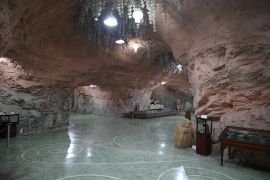 Sulaiman-Too in Osh
 -
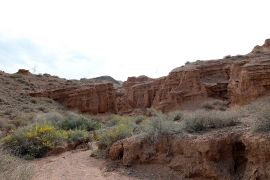 Kok-Moynok Canyons
 -
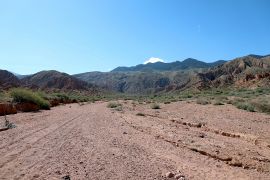 Mars Canyons
 -
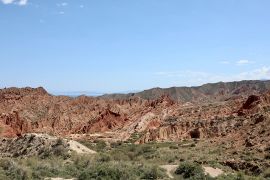 Skazka Canyon
 -
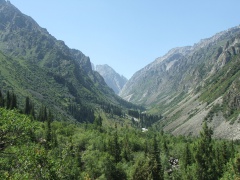 Ala-Archa Gorge
 -
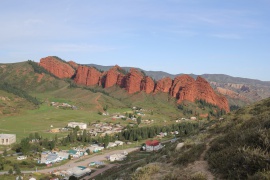 Red rocks of Jeti-Oguz
 -
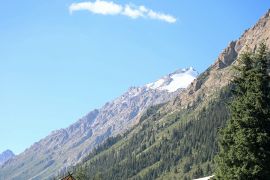 Barskoon Gorge
 -
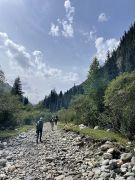 Karakol Gorge
 -
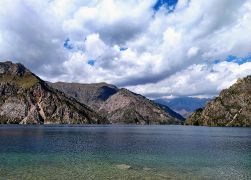 Sary-Chelek Lake
 -
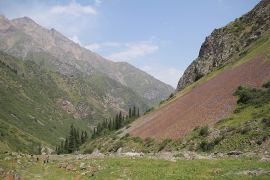 Kegety Gorge


Articles about Kyrgyzstan in WikiJournal
See also
Sources
- ↑ Kyrgyzstan Country Factsheet // The World Factbook, CIA
- ↑ 2.0 2.1 Population // National Statistical Committee of the Kyrgyz Republic
- ↑ 3.0 3.1 Kyrgyzstan's population reaches almost 7.4 million people // Kabar
- ↑ 4.0 4.1 Kyrgyzstan — World Leaders // CIA
- ↑ Kyrgyz Republic // World Bank Open Data