

Orto-Tokoy Reservoir


Issyk-Kul Region
Longitude: 75°57′20″


Orto-Tokoy Reservoir (Kyrgyz: Орто-Токой суу сактагычы) is an artificial reservoir on the Chu River in Kyrgyzstan, located at the junction of Naryn and Issyk-Kul regions, near the village of Orto-Tokoy and the road between Kochkor, Balykchy and the southern shore of Issyk-Kul. The reservoir was created for seasonal regulation of the Chu River and for irrigation in the Chuy Valley.[1][2]
It is one of the oldest major hydraulic structures in Kyrgyzstan. Construction began in 1941, was interrupted during the Second World War, and was completed in the post-war period. The reservoir entered operation in the mid-20th century and became an important water-management facility in the Chu basin.[1][3]
Geography
Orto-Tokoy Reservoir lies in a mountain basin on the Chu River, about 2 km west of the village of Orto-Tokoy. Administratively, the site is located near the border of Naryn and Issyk-Kul regions; nearby reference points include the Kochkor Valley, Balykchy and the western part of the Issyk-Kul basin.[2]
The reservoir lies at an elevation of about 1700 m above sea level. Its shores are surrounded by dry mountain slopes and open steppe-like areas, so the landscape differs sharply from the greener gorges of northern Kyrgyzstan. From the southern and western sides the water body appears especially broad, while at low water levels shallow shoreline areas and exposed banks become visible.
The surface area is about 26 km², and the full storage volume is about 470 million m³. The dam is about 52 m high, about 365 m long and about 6 m wide along the crest.[2][3]
Construction history
The reservoir project was prepared before the Second World War. Construction started in 1941 but was soon suspended. The main stage was completed in 1960, when Orto-Tokoy became the first large artificial reservoir built in Kyrgyzstan.[1]
Orto-Tokoy Reservoir was designed primarily as an irrigation facility. Its role is to accumulate water during periods of higher runoff and then release it for agriculture. The reservoir regulates the flow of the Chu River and is connected with irrigation in the Chuy Valley, including areas in Kyrgyzstan and Kazakhstan.[2]
Some elements of Soviet-era hydraulic infrastructure and decorative design have been preserved at the site. A mosaic on the reservoir grounds is one of the rare examples of Soviet monumental decoration associated with engineering structures.[1]
Water-management role
The main function of Orto-Tokoy Reservoir is seasonal water regulation for irrigation. In winter and spring, the reservoir fills; during the warm months, water is gradually released for agricultural use. As a result, the water level changes noticeably by season: in early summer the reservoir is usually fuller, while by late summer and autumn the visible water area may decrease.
The reservoir belongs to the Chu River basin, which is important for agriculture in northern Kyrgyzstan. Flow regulation helps maintain water supply to fields in the Chuy Valley, where a significant part of the country's agricultural land is concentrated.[2][3]
Orto-Tokoy Hydropower Plant
In the 2020s, construction began near the reservoir on the small Orto-Tokoy Hydropower Plant. The planned installed capacity is 21 MW, with three 7 MW units. The plant is intended to use the existing water-management node and the reservoir outlet.[4]
By early 2026, construction readiness was estimated at about 80%, with commissioning planned for 2026. In May 2026, work was still underway, including spillway construction.[5][6]
Landscape
Orto-Tokoy Reservoir is notable not only as an engineering structure but also as a striking landscape point on the route between Bishkek, Kochkor, Balykchy and Issyk-Kul. The reservoir is surrounded by dry mountains, open slopes and broad shorelines. In clear weather the water reflects the sky and mountains, while at low water levels long light-colored strips of shoreline appear.
The site is especially expressive in spring and early summer, when the reservoir is fuller and the surrounding slopes look softer in color. In autumn and during dry periods the reservoir becomes more austere: the water recedes, the banks widen and the relief around the dam and shoreline becomes more visible.
Visiting
The reservoir is convenient to view during a trip from Bishkek to the southern shore of Issyk-Kul or toward Kochkor and Naryn. The road passes near the water, so the reservoir is often visited as a short stop on the way rather than as a separate long route.[7]
Southern shoreline areas are more open and gently sloping, while the northern and northwestern parts are rockier and more irregular. When stopping by the water, seasonal changes in water level, wind and the condition of dirt access roads should be considered. The reservoir remains an operating hydraulic facility, so restrictions near the dam and technical structures must be observed.
Photo gallery
-
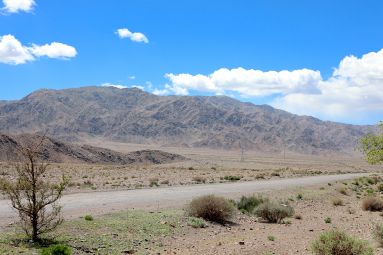 Mountains near the reservoir
 -
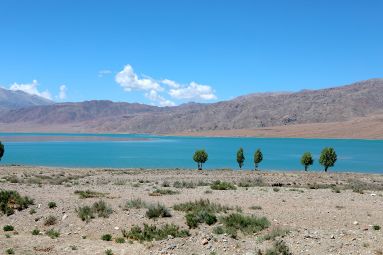 Near the southern shore of the reservoir
 -
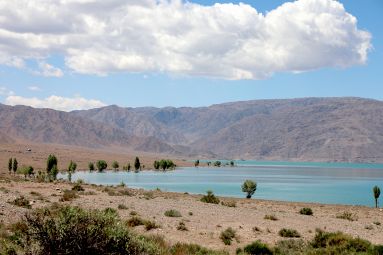 Reservoir shore
 -
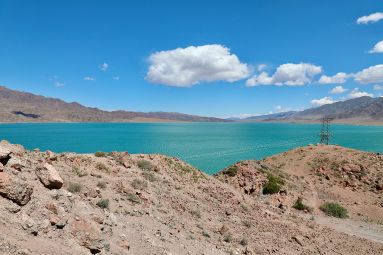 Panorama from the northwest


Author's note
Orto-Tokoy Reservoir is well suited for a short stop while traveling to Issyk-Kul or Naryn Region. The place is interesting not only for its water surface, but also for the combination of an engineering structure, dry mountain slopes and the open space of the Chu basin.
Questions, comments and additions can be left on the article's discussion page.
Other articles about lakes and reservoirs in Kyrgyzstan
See also
References
- ↑ 1.0 1.1 1.2 1.3 Фоторепортаж: как сегодня выглядит первое водохранилище Кыргызстана — Орто-Токой // Water Resources Service of the Ministry of Agriculture of the Kyrgyz Republic.
- ↑ 2.0 2.1 2.2 2.3 2.4 Орто-Токойское водохранилище // Open.kg.
- ↑ 3.0 3.1 3.2 National report on the state of the environment of the Kyrgyz Republic for 2015—2018 // Aarhus.kg.
- ↑ Орто-Токойскую ГЭС запустят уже в 2026 году // Economist.kg.
- ↑ Строительство Орто-Токойской ГЭС завершено на 80 %, запуск ожидается в первом полугодии // Economist.kg.
- ↑ Information bulletin, 25—29 May 2026 // CAWater-Info.
- ↑ Орто-Токойское водохранилище // Trip to Kyrgyzstan.