

Maiden Braids waterfall


Longitude: 78°15′11″


Maiden Braids Waterfall is a mountain waterfall in Kyrgyzstan, situated in Jeti-Oguz Gorge in Issyk-Kul Region, on the northern slopes of the Terskey Ala-Too range. English-language travel sources also call it Maiden Tears Waterfall. Both names refer to the narrow streams of water that divide across the rock face, resembling long hair or falling tears.[1][2]
The waterfall lies in the upper Jeti-Oguz valley, beyond the resort area and the famous red formations known as the Seven Bulls and Broken Heart. It is one of the gorge's most popular natural destinations and can be reached on foot or horseback, or included in a day trip along the southern shore of Issyk-Kul.[3]
Location
The waterfall is located in Jeti-Oguz Gorge, approximately 25–30 km southwest of Karakol and about 30 km from the shore of Issyk-Kul. The road passes through the village and resort area of Jeti-Oguz before continuing up the valley towards summer pastures and spruce-covered slopes.[3]
The waterfall stands at an elevation of roughly 2,400–2,600 metres above sea level. Sources give varying figures for the height of the cascade, generally between 20 and 25 metres. Some travel descriptions suggest larger measurements, but about 20–25 metres is the more cautious estimate.[2][4]
Characteristics
The waterfall is formed by a small mountain stream that descends over a rocky slope and continues towards the Jeti-Oguz valley. Its flow is not massive, but the contours of the rock remain clearly visible as the water separates into several strands, creating the pattern from which the waterfall takes its name.
The cascade is most expressive during the warm season, when melting mountain snow and rainfall feed the stream. Its flow may diminish in late summer and autumn, but the surrounding scenery remains striking: coniferous woods, open slopes, red rock formations, and broad views along the valley.
Route to the waterfall
Trips usually begin in Karakol or elsewhere on the southern shore of Issyk-Kul. A motor road leads into the lower gorge and continues up the valley. Farther into Jeti-Oguz, it crosses the river by bridges and passes through pastures and forested sections.
From the usual vehicle stopping point, the waterfall is reached on foot. Depending on the exact starting place, weather, road conditions, and the fitness of the group, the walk generally takes between 30 minutes and an hour. Horse rides are also commonly offered, making the route more accessible to visitors who do not wish to walk the entire distance.[3]
Nearby places
A visit to the waterfall can be combined with other attractions in Jeti-Oguz:
- the Seven Bulls red rock formation;
- the Broken Heart rock;
- the Jeti-Oguz resort area;
- the Kok-Jaiyk valley and its summer pastures;
- viewpoints along the road into the upper gorge.
This combination makes a good day trip from Karakol, bringing together several characteristic landscapes of southern Issyk-Kul: red sandstone cliffs, coniferous slopes, a mountain river, and the waterfall.
Season and safety
The best period to visit is from late spring to early autumn. The waterfall is usually fuller in spring and early summer, although the paths may be wet. Summer offers easier weather, but popular points along the route can be busier. In autumn, the flow is quieter while the colours and contrasts of the valley become especially pronounced.
Visitors should observe several basic precautions:
- wear comfortable footwear with non-slip soles;
- avoid stepping too close to wet rocks beside the stream;
- do not continue uphill during thunderstorms, heavy rain, or a sudden deterioration in the weather;
- carry drinking water, a windproof jacket, and a warm layer even in summer;
- approach horse riding carefully if inexperienced.
Tourism
Maiden Braids is one of the natural sites that make Jeti-Oguz more than a brief stop beside its famous red cliffs. The waterfall draws visitors deeper into the gorge and reveals a quieter, less developed part of the valley beyond the principal viewpoints.
For photographers, the site is valued less for sheer scale than for its setting. Thin streams against dark rock, green slopes, the trail, and the mountain landscape provide a varied visual account of Jeti-Oguz.
Waterfall photographs
- Maiden Braids Waterfall and the route leading to it
-
 On the way to the waterfall
-
 View along the route
-
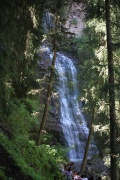 Approaching the waterfall
-
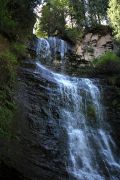 General view
-
 Streams of the waterfall
-
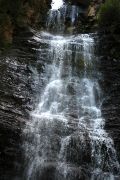 Flowing water
-
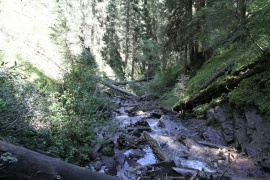 Below the waterfall
-
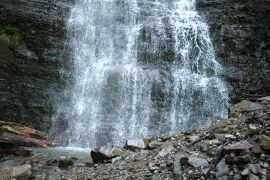 At the foot of the waterfall
-
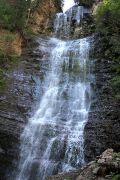 General view
-
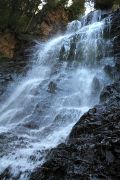 Beside the stream
-
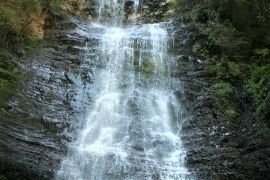 Water cascades
-
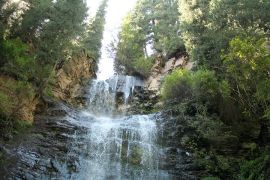 Base of the waterfall
-
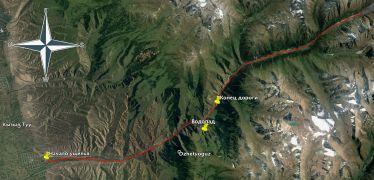 Map of the gorge and waterfall


Author's note
Visitors to Jeti-Oguz need not limit their trip to the Seven Bulls and Broken Heart formations. The walk to the waterfall gives a fuller sense of the gorge through the sound of the river, the scent of coniferous forest, open pastures, and the gradual transition from the resort area to a mountain landscape.
Additional information, recent photographs, and personal accounts can be shared on the article's discussion page.
See also
References
- ↑ Waterfall Maiden Tears // DWC
- ↑ 2.0 2.1 Maiden Tears Waterfall // Trip to Kyrgyzstan
- ↑ 3.0 3.1 3.2 Jeti-Oguz sights // Central Asia Guide
- ↑ Maiden Braids Waterfall // Turizmvnn