

Turgen-Aksu Gorge


Longitude: 78°53'15"


Turgen-Aksu Gorge is a scenic gorge in Kyrgyzstan, in the Tyup district of the Issyk-Kul region, about 40 km east of Karakol. It is part of the Terskey Ala-Too mountain range.
A road about 25 km long runs deep into the gorge, passing through the Chon-Ashu Pass toward the valley of Sary-Jaz gorge and farther toward the Inylchek mountain area. This makes the gorge relatively convenient to visit. The road was built during the Soviet period in connection with the development of a gold-mining complex, and today it allows visitors to travel far into the gorge by car.
Questions, corrections, and comments about visiting the gorge can be discussed on the discussion page.
Gorge geography
The gorge is located in the eastern part of Kyrgyzstan, not far from the Kyrgyz-Kazakh border, approximately 40 km east of the regional administrative center, Karakol. It extends from north to south for about 30-35 km. The entrance to Turgen-Aksu Gorge lies at an elevation of about 2,060 meters above sea level, while the upper part of the valley near the source of the Kok-Kiya River reaches about 3,000 meters.
Maral deer still inhabit Turgen-Aksu Gorge. In the upper reaches of the gorge, some of the oldest Precambrian rocks are found, including gneiss, granite, quartzite, crystalline schists, and marble.[1]
Tourist routes

———— road route along the gorge with a turn toward the Sary-Jaz valley
———— continuation of Turgen-Aksu Gorge along the Kok-Kiya River.
Because of the large area of the gorge and its considerable elevation difference, there are many scenic places to visit. A dirt road runs through much of the gorge, so a trip by car can be planned.
Both active and quiet recreation are possible in the valley. The Kok-Kiya River flows through the gorge; its name can be translated as "green slope". Visitors can follow a route along the river or stop for a picnic. From the entrance to the gorge up to the turn toward Sary-Jaz Gorge, the mountain slopes are covered with spruce forests, where visitors can walk and enjoy the local scenery. For those looking for more physically demanding activities, it is possible to climb one of the many surrounding peaks, which reach 3,800-4,000 meters. From late autumn to spring, the upper part of the gorge can attract fans of mountain extreme sports. Such routes should be planned with local guides, as attempting them independently can be dangerous.
In summer, some tour companies from Karakol and Cholpon-Ata organize trips to this part of the Issyk-Kul region.
How to get there
The nearest large settlement to the gorge is Karakol. From Karakol, the route goes toward the villages of Teploklyuchenka, Novovoznesenovka, and Ak-Bulun. The total distance is about 40 km. In Ak-Bulun, the road turns south into Turgen-Aksu Gorge. Some tour companies also organize trips to the gorge from Cholpon-Ata.
Gorge photo gallery
- Photos of Turgen-Aksu Gorge
-
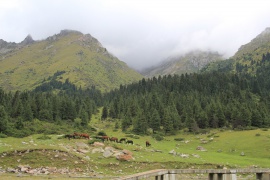 Mountain slopes near the entrance to the gorge
 -
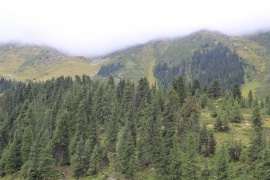 Spruce forests on the mountain slopes
 -
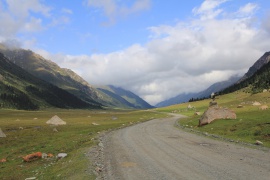 Valley of Turgen-Aksu Gorge
 -
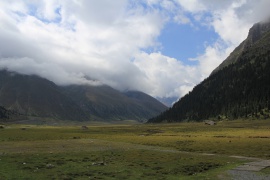 Open spaces of the gorge valley
 -
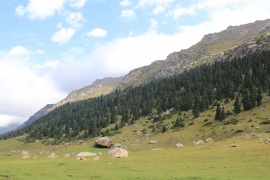 Western mountain slopes of the gorge
 -
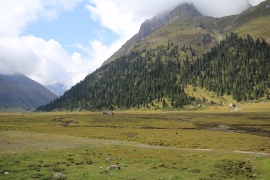 In the gorge valley
 -
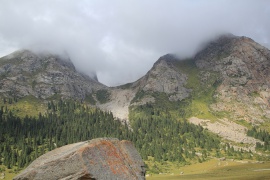 Where the sky meets the earth
 -
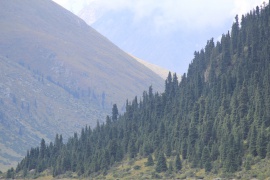 Dense spruce forests on the mountain slopes
 -
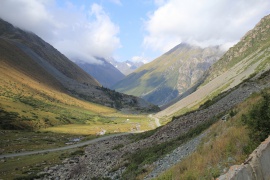 The valley from the Sary-Jaz side


Interesting facts
- In the depths of the valley, snow remains on the mountain peaks even in summer, and there are numerous glaciers. This attracts fans of extreme sports such as freeride skiing and rafting.
- Toward the valley of Sary-Jaz Gorge, small alpine lakes have formed among the mountain peaks. They are locally known as Jash-Kol, meaning "young lakes", and can be reached on foot.
- In late summer, when climbing to the summits, visitors can experience the so-called "four seasons" of nature: the weather can change rapidly from warm sunshine to snow and strong wind.