

What to See in Istanbul: Top Most Significant Sights


28°57′37″ E


Istanbul is Turkey's largest city and extends along both shores of the Bosphorus. Known in different periods as Byzantium and Constantinople, it served as the capital of the Byzantine and Ottoman empires. Ankara is the capital of modern Turkey, while Istanbul remains the country's principal economic, cultural and transport centre.
The Historic Areas of Istanbul are a UNESCO World Heritage Site. They include the Sultanahmet archaeological area, the Süleymaniye quarter, Zeyrek and sections of the Theodosian land walls.[1]
Main sights
Topkapı Palace
Topkapı Palace was the residence of the Ottoman sultans and the centre of imperial government for almost four centuries. Construction began under Mehmed II in the 1460s. The complex consists of courtyards, pavilions and service buildings; its best-known sections include the Harem, the Imperial Treasury and the Chamber of Sacred Relics. The palace became a museum in 1924.[2]
Visitors should allow several hours for the large complex. Hagia Irene, the Istanbul Archaeological Museums and Gülhane Park are nearby.
- Topkapı Palace
-

-

-

-

-


Hagia Sophia
Hagia Sophia was built in 532–537 during the reign of Justinian I. It was the principal church of the Byzantine Empire until 1453, then became a mosque, operated as a museum from 1935 and was reconverted into an active mosque in 2020. Its architecture, Byzantine mosaics and Ottoman furnishings preserve several layers of the city's history.[1]
Since January 2024, worshippers and foreign tourists have used separate routes; the cultural visitor route passes through the upper gallery. Admission arrangements and ticket prices may change and should be checked before a visit.[3]
- Hagia Sophia
-

-

-

-


Blue Mosque
The Blue Mosque, or Sultan Ahmed Mosque, was built in 1609–1617 for Sultan Ahmed I. Its six minarets created an unusual silhouette for the period, while thousands of blue-and-white İznik tiles gave the building its popular name. It forms part of the UNESCO-protected Sultanahmet area.[1]
The building remains an active mosque. Tourist access is restricted during prayers, and visitors are expected to observe the dress and conduct rules of a place of worship.
- Blue Mosque
-

-

-

-


Süleymaniye Mosque
The Süleymaniye Mosque was designed by Mimar Sinan for Suleiman the Magnificent and built in 1550–1557. It stands at the centre of a large social complex that originally included schools, a hospital, kitchens, a bath and a caravanserai. The mausoleums of Suleiman I and Hürrem Sultan are beside the mosque, and the terrace overlooks the Golden Horn.[1]
- Süleymaniye Mosque
-

-

-

-


Princes' Islands
The Princes' Islands form an archipelago in the Sea of Marmara. Büyükada is the largest and most visited island; regular ferries also call at Heybeliada, Burgazada and Kınalıada. Wooden houses from the nineteenth and early twentieth centuries and the absence of ordinary private motor traffic make the islands well suited to walking.
Municipal ferries run from Kabataş, Beşiktaş, Bostancı, Maltepe and other terminals. Routes and timetables vary by season.[4]
- Princes' Islands
-

-

-

-


Galata Tower
Galata Tower was built by the Genoese in the mid-fourteenth century as part of the fortifications of their Galata colony. During the Ottoman period it served first as a prison and later as a fire lookout. Following restoration in 2020, it reopened as a museum; its upper floor provides a broad view across the historic city.[5]
- Galata Tower and views from it
-

-

-

-


Bosphorus
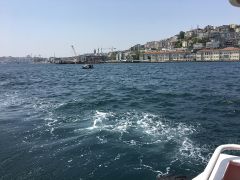
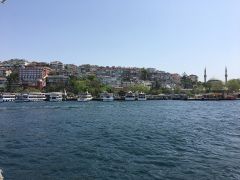
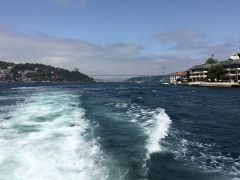
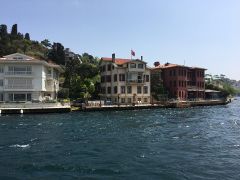
The Bosphorus connects the Black Sea with the Sea of Marmara and separates Istanbul's European and Asian sides. From the water, passengers can see Dolmabahçe and Beylerbeyi palaces, Ortaköy Mosque, Rumeli Fortress, Ottoman waterfront mansions and the three road bridges.
The municipal ferry company offers short and long Bosphorus tours. Ordinary commuter ferries between European and Asian terminals provide a shorter and less expensive alternative.[4]
- Views of the Bosphorus
-
-
-
-


Other places to visit
- The Basilica Cistern, a sixth-century underground reservoir supported by hundreds of columns.
- The Grand Bazaar and Spice Bazaar, historic commercial districts.
- Dolmabahçe Palace, a nineteenth-century ceremonial residence of the Ottoman sultans.
- Chora, a former Byzantine church with fourteenth-century mosaics and frescoes, now an active mosque.
- Üsküdar and Kadıköy, lively districts on Istanbul's Asian side that are easily reached by ferry.
Suggested three-to-five-day itinerary
| Day | Area | Main route |
|---|---|---|
| 1 | Sultanahmet | Hagia Sophia, Blue Mosque, Hippodrome and Basilica Cistern |
| 2 | Historic peninsula | Topkapı Palace, Archaeological Museums, Gülhane Park and Eminönü |
| 3 | Süleymaniye and Beyoğlu | Süleymaniye Mosque, Grand Bazaar, Galata Bridge and Galata Tower |
| 4 | Bosphorus and Asian side | Bosphorus trip, Üsküdar and Kadıköy |
| 5 | Outside the centre | Princes' Islands, or Dolmabahçe Palace and Beşiktaş |
Practical advice
- Museum opening hours, prices and admission rules change; consult the official website shortly before visiting.
- Hagia Sophia, the Blue Mosque and Süleymaniye are active mosques. Allow for prayer times and dress appropriately.
- A rechargeable Istanbulkart is convenient for public transport. Many sights on the historic peninsula are within walking distance of one another.
- Spring and autumn are usually milder than summer, but the weather beside the Bosphorus can change quickly and be windy.
References
- ↑ 1.0 1.1 1.2 1.3 Historic Areas of Istanbul // UNESCO World Heritage Centre.
- ↑ Topkapı Palace Museum // Ministry of Culture and Tourism of Türkiye.
- ↑ New visitor arrangement at Hagia Sophia // Ministry of Culture and Tourism of Türkiye. 12 January 2024.
- ↑ 4.0 4.1 Timetables // Şehir Hatları.
- ↑ Galata Tower Museum // Ministry of Culture and Tourism of Türkiye.