

Stuffed pepper

Stuffed pepper is a hot dish made from sweet peppers filled with meat or vegetable stuffing and stewed in tomato sauce. In different forms, the dish is common in the cuisines of the Balkans, Eastern Europe, the Caucasus and the countries of the former USSR. The filling most often consists of minced meat, rice, onion and carrot, but the exact composition can vary depending on local tradition and household preferences.
Stuffed pepper is convenient because it combines a main course and a side dish: the pepper gives aroma and shape, the meat makes the dish hearty, the rice absorbs juices and sauce, and the tomato gravy brings all the ingredients together. The dish works well for a family lunch, dinner or cooking ahead for several days.
Features of the dish
For stuffing, it is better to choose firm medium-sized sweet peppers. They should be large enough to hold the filling, but not too wide: such peppers are easier to place in a pot and stew evenly.
Rice is usually boiled until half-cooked. If completely raw rice is used, it may absorb too much moisture from the filling and sauce. If fully cooked rice is used, the filling will be softer and less firm. Half-cooked rice gives the most balanced result.
The sauce may be tomato-based, sour cream and tomato-based, or vegetable-based. In the classic homemade version, tomato juice, puréed tomatoes, tomato paste, water or broth are used. There should be enough liquid for the peppers to stew rather than burn at the bottom of the pot.
Ingredients
Approximate ingredients for 8–10 medium peppers:
- sweet bell peppers — 8–10 pieces;
- minced meat — 500–700 g;
- rice — 100–150 g dry weight;
- carrot — 1 large;
- onion — 1–2 heads;
- tomato juice, puréed tomatoes or tomato sauce — 600–800 ml;
- water or broth — as needed;
- vegetable oil — for frying;
- salt and black pepper — to taste.
Beef, pork, chicken, turkey or mixed minced meat can be used for the filling. A juicier version is made with mixed meat, for example beef and pork. A lighter version can be made with chicken or turkey.
Optional ingredients
The dish may also include:
- garlic;
- bay leaf;
- ground paprika;
- fresh herbs;
- sour cream;
- hot pepper;
- a little sugar in the tomato sauce if it is too acidic.
In a lean or vegetarian version, minced meat can be replaced with a mixture of rice, vegetables, mushrooms, beans, lentils or bulgur.
Preparing the peppers
Wash the peppers, then carefully cut off the top or remove the stem with the seed core. It is better to remove the inner membranes and seeds completely so that the filling sits evenly and the finished dish does not taste bitter.
If the peppers are firm and thick-walled, they can be placed in boiling water for 1–2 minutes. This softens the walls and makes them easier to arrange in the pot. Young or thin-walled peppers can be stuffed without blanching.
Preparing the filling
- Rinse the rice and boil it until half-cooked, then drain it in a sieve.
- Finely chop the onion and grate the carrot on a coarse grater.
- Fry the onion and carrot in vegetable oil until soft.
- Mix the minced meat, rice and part of the fried vegetables.
- Add salt, pepper and spices, then mix well.
The filling should not be too dry. If the minced meat is dense, add a few spoonfuls of water, broth or tomato sauce. This will make the finished dish juicier.
Cooking method
- Fill the prepared peppers with the stuffing, without packing it too tightly: the rice will expand slightly during stewing.
- Place the peppers upright in a pot or deep sauté pan, cut side up.
- Mix tomato juice or sauce with water, salt, pepper, bay leaf and the remaining fried vegetables.
- Pour the sauce over the peppers so that the liquid reaches about half or two thirds of their height.
- Bring to a boil, then reduce the heat and simmer covered for 50–70 minutes.
- At the end of cooking, taste the sauce and add more salt if necessary.
The dish is ready when the pepper, rice and meat are soft. If the peppers are large, cooking time may be closer to 70–80 minutes. If chicken mince and small peppers are used, the dish usually cooks faster.
Serving
Stuffed peppers are served hot with the sauce in which they were stewed. Sour cream, fresh herbs, green onion, dill, parsley and soft bread go well with the dish.
If the sauce is too thin, it can be reduced slightly without a lid or thickened with a spoonful of sour cream. For a richer flavour, part of the tomato sauce can be replaced with vegetable gravy made from fried onion, carrot and garlic.
Storage and reheating
Stuffed peppers keep well in the refrigerator for 2–3 days in a closed container. When reheating, it is better to add a little sauce or water so that the peppers do not dry out.
The dish can also be frozen. It is more convenient to freeze peppers that have already been stuffed but not yet stewed. In winter, such preparations can be placed directly in a pot, covered with sauce and cooked without lengthy preparation.
Recipe variations
There are many homemade variations of stuffed pepper:
- with meat and rice — the most common version;
- with chicken or turkey — a lighter version;
- with vegetables and mushrooms — a lean version;
- with sour cream and tomato sauce;
- baked in the oven instead of stewed in a pot;
- with herbs, garlic, paprika or hot pepper.
In some cuisines, similar dishes are prepared not only with sweet peppers, but also with tomatoes, eggplants, zucchini, grape leaves or cabbage leaves.
Preparation photos
- Preparing stuffed peppers
-
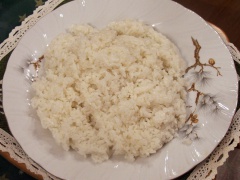 Rice boiled until half-cooked
 -
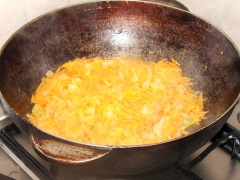 Fried onion and carrot
 -
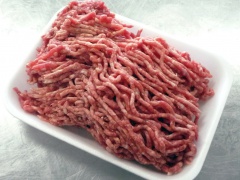 Minced meat
 -
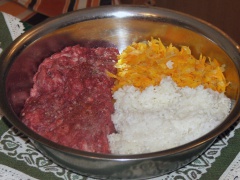 Filling of meat, rice and vegetables
 -
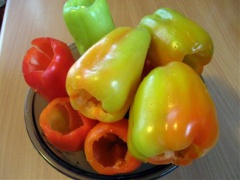 Cleaned peppers for stuffing
 -
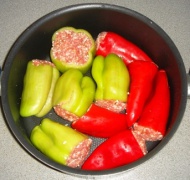 Filling the peppers
 -
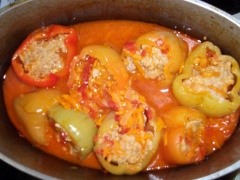 Stewing stuffed peppers
 -
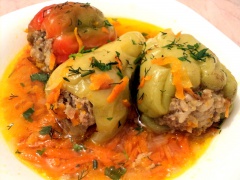 The finished dish


Author's note
Stuffed peppers are convenient to cook in a larger quantity: the next day the dish often becomes even tastier because the filling absorbs more of the sauce. If you have your own versions of the filling, sauce or serving, you can share them on the talk page.