

Sigma AF 150-600mm f/5.0-6.3 DG OS HSM

Canon EF
Nikon F
max. magnification 1:4.9
also usable on APS-C
1,830 g with protective cover instead of tripod socket

Sigma 150-600mm F5-6.3 DG OS HSM Contemporary is a super-telephoto zoom lens made by Sigma for DSLR cameras. The lens belongs to Sigma's Contemporary line, is designed for full-frame cameras, and was produced for Sigma SA, Canon EF, and Nikon F mounts.[1]
The 150-600 mm range makes the lens suitable for birds, wildlife, distant details, the Moon, sports, and scenes that the photographer cannot physically approach. On APS-C cameras the field of view becomes even narrower because of the crop factor, which can be useful for photographing distant subjects.
Sigma also produced the heavier and more protected 150-600mm F5-6.3 DG OS HSM Sports version. The Contemporary version is lighter and more compact, but it is less rugged than the Sports model. Sigma lists the Contemporary version as discontinued on its official website.[1]
Lens usage
The Sigma 150-600mm Contemporary is intended for subjects where a very long focal range matters. It can be used for birds, animals, aircraft, sports events, mountain peaks, architectural details, and other distant subjects. At the same time, the lens remains large and heavy, so a monopod, tripod, or stable support is often useful during long shooting sessions.
Advantages
The main advantages of the lens include:
- Long focal range. The 150-600 mm range allows the photographer to move from moderate telephoto framing to very strong magnification without changing lenses.
- Relatively accessible price. In its class, the lens is often considered a more affordable alternative to brand-name Canon and Nikon super-telephoto lenses.
- Optical stabilization. The OS system helps reduce blur caused by camera shake during handheld shooting at long focal lengths.
- HSM autofocus. The Hyper Sonic Motor provides autofocus suitable for many bird, wildlife, and sports subjects in good light.
- Detachable tripod socket. The tripod socket can be removed and replaced with a protective cover, reducing the weight to 1,830 g.[1]
- Protected mount. Sigma states that the mount has rubber sealing to protect it from dust and water drops.[1]
Limitations
The limitations of the lens include:
- Weight and size. At about 1,930 g, handheld shooting can become tiring, especially with a full-frame camera.
- f/6.3 aperture at the long end. At 600 mm the lens requires good light, higher ISO, or slower shutter speeds.
- Autofocus at 600 mm depends on conditions. In low light, low contrast, or fast subject movement, focusing may become less reliable.
- Fast shutter speeds are still needed. For birds, sports, and animals, stabilization does not replace a fast shutter speed because it cannot stop subject movement.
- Transport. The lens takes considerable space in a backpack and requires a larger camera bag.
Lens characteristics
Optical construction
The optical design consists of 20 elements in 14 groups.[1] Sigma states that the lens uses one FLD element and three SLD elements to reduce chromatic aberrations, especially at the telephoto end.[1] The diaphragm has 9 rounded blades.
Focal length and angle of view
The 150-600 mm range gives an angle of view from 16.4° to 4.1° on full frame.[1] At 150 mm the lens is suitable for tight framing, distant portraits, and remote details; at 600 mm it is useful for birds, wildlife, the Moon, aircraft, and objects at great distance.
On APS-C cameras the actual focal length does not change, but the field of view becomes narrower. As a result, the lens may feel even longer, which can be useful for wildlife photography.
Autofocus
The lens uses an HSM autofocus drive. Sigma describes it as quieter and faster, with an improved algorithm for continuous autofocus.[1] In practice, autofocus effectiveness depends on the camera, lighting, subject contrast, and selected focal length.
At 600 mm and f/6.3, autofocus has a more difficult task in twilight or when photographing fast subjects. For birds in flight and sports, good light, a fast shutter speed, and a camera with a strong autofocus system are especially important.
Image stabilization
The lens is equipped with OS (Optical Stabilizer). Sigma lists two stabilization modes: a general mode and a panning mode for moving subjects.[1] Stabilization is useful for static subjects shot handheld, but birds, animals, and sports still require sufficiently fast shutter speeds.
Sharpness and image quality
For its class, the Sigma 150-600mm Contemporary provides good results, especially considering its focal range and price. At the shorter and middle parts of the zoom range, sharpness is generally perceived as stronger. At 500-600 mm, image quality can decrease, and better results often require stopping down to f/8-f/11, using stable support, and focusing carefully.
Chromatic aberrations, flare, and reduced contrast may appear in difficult conditions, but they are partly controlled by the optical design, coatings, and later processing.
Bokeh and perspective compression
Long focal lengths make it possible to separate the subject strongly from the background even at f/6.3. When photographing birds, animals, and portraits from a distance, the background can become softly blurred and the perspective appears visually compressed. This effect is difficult to obtain with short focal length lenses.
For stronger background blur, the distance between the subject and the background is important: the farther the background is from the subject, the stronger the blur becomes.
Practical use
When working with the lens, several practical points are useful:
- at 600 mm, a fast shutter speed is desirable, especially for birds and animals;
- for long walks, a monopod or a strap designed for heavy lenses can be useful;
- when shooting handheld, OS stabilization is helpful, while tripod use should take into account the manufacturer's recommendations and actual conditions;
- the lens is sensitive to haze, heat shimmer, and dirty air: when photographing distant objects, atmospheric conditions may affect sharpness more than the lens itself;
- transport requires attention to the length, weight, and protruding tripod socket.
Sample photographs
- Photographs taken with the Sigma 150-600mm F5-6.3 DG OS HSM Contemporary
-
 Focal length: 600 mm; shutter speed: 1/320; aperture f/6.3; ISO 1000
 -
 Focal length: 600 mm; shutter speed: 1/400; aperture f/6.3; ISO 1600
 -
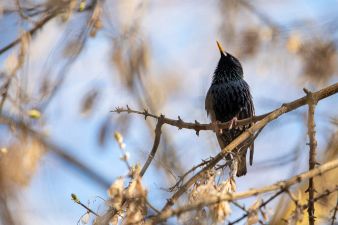 Focal length: 600 mm; shutter speed: 1/800; aperture f/6.3; ISO 1600
 -
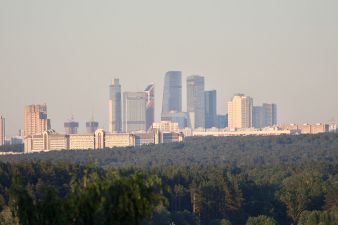 Focal length: 600 mm; shutter speed: 1/200; aperture f/6.3; ISO 200
 -
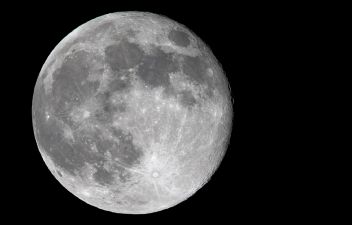 Focal length: 600 mm; shutter speed: 1/1600; aperture f/6.3; ISO 3200
 -
 Focal length: 150 mm; shutter speed: 1/320; aperture f/8; ISO 100
 -
 Focal length: 300 mm; shutter speed: 1/500; aperture f/8; ISO 320
 -
 Focal length: 600 mm; shutter speed: 1/1000; aperture f/6.3; ISO 200
 -
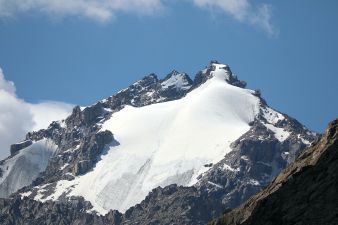 Glacier at a distance of about 20 km


The photographs above were taken with a Canon 5D Mark IV full-frame camera. Moscow City was photographed at 600 mm from a distance of about 18 km; the Moon image was cropped from the full frame to 1680 x 1074 pixels.
Overall assessment
The Sigma 150-600mm F5-6.3 DG OS HSM Contemporary is a practical super-telephoto zoom for photographers who need a long focal range without moving to much more expensive professional 500-600 mm prime lenses. It is well suited for wildlife, birds, the Moon, distant landscape details, and sports in good light.
The main trade-offs are weight, size, f/6.3 aperture at the long end, and the dependence of results on light, shutter speed, camera stability, and atmospheric conditions. The lens is most justified when the photographer is willing to accept the size in exchange for a 600 mm focal length.
The more expensive Sigma AF 60-600mm f/4.5-6.3 DG OS HSM Sports should also be considered: it has a wider focal range, but it is more expensive and heavier.
If you have experience with this lens or questions about using it, you can leave a message on the discussion page.